Co-Care
Recovery needs a structure people can return to
Co-Care is built around three stages: Prepare, Align and Act.
Each one answers a question from the research. Prepare helps people put their needs into words, Align connects them with the right support, and Act turns the plan into daily routines. Families can return to any stage when something changes.
How might we support patients with rare chronic conditions and their
caregivers through the move from treatment to rehabilitation?
The research showed that families manage recovery alone once treatment ends, caught in three loops that feed each other. Each loop became a design question.
How might we
provide the patients and
caregivers with vocabulary
that can help them
structure their thoughts
How might we
design an integrated
service for navigation and
guidance support from
emerging roles in care
How might we
reduce the trial and error
approach and provide the
right structures so they can
identify the triggers causing
relapse
Prepare
Before you can act for sense-making you need a vocabulary of your own.
Align
Connect with coach, by the topic and concern you actually want help with.
Act
Find personalised trackers or resources for your care management.
Finding Co-Care
Co-Care reaches families at the point where care usually stops
The research showed that no one hands patients over when treatment ends. So Co-Care is designed to meet them at that moment. It partners with doctors, clinics and hospitals, and appears at discharge or at the start of rehabilitation, through a doctor's recommendation or a brochure in the waiting room. Local campaigns and word of mouth reach families outside the hospital.

Discover
A doctor recommends Co-Care, or the patient or caregiver picks up a brochure at the clinic.

Visit
They go to the Co-Care website to learn how the service works.

Try it Out
A short form asks about their situation and recommends the subscription that fits their needs.
Prepare
Prepare is where families start. Through a set of themed questions, patients and caregivers choose the topics that matter to them right now, across the five dimensions of rehabilitation. They then narrow a topic into a specific focus, which the platform uses to recommend the right coach.
Families leave the hospital without the words to say what they need
Research participants arrived at appointments unprepared and overwhelmed. They had questions, but no way to organise them.

Themes across five dimensions. Topics cover understanding the condition, planning care, finding resources, tracking progress and emotional support.
Choosing is a way of understanding. Seeing options like "I don't know what to ask" helps families recognise and name their own situation.
From topic to focus. Users narrow a broad topic into a specific question to work on.
Coach recommendation. Their focus filters the list of coaches down to the ones who fit.
Made for both roles. Content is shaped for patients and caregivers, and either can start.
A clear starting point for patient and caregiver
Families arrive at their first coaching session knowing what they want to work on. The time between leaving the hospital and understanding what to do next gets shorter, and caregivers have a way to share their own needs, not only the patient's.
2. Align
Align connects families with the right person. Based on the focus they chose in Prepare, the platform shows a shortlist of matched, verified coaches. Families compare profiles, book a 30-minute session, online or in person, and work out realistic goals with the coach. After the session, the coach writes a summary and sets up the trackers for the next stage,.
Families don't know whom to turn to, so they rely on whoever is nearby
Research participants found help through friends, forums and chance recommendations. Care coaches existed, but families had no way to find one they could trust, and no one to talk to about what they were going through.

Matched, not searched. The focus chosen in Prepare filters coaches down to the ones who fit.
Profiles that build trust. Each coach shows their specialisation, approach, reviews and verified credentials.
A 30-minute session, online or in person. At home or at the coach's clinic.
Goals that match reality. The coach helps turn what the family hopes for into steps they can manage.
A shared summary. After the session, the coach writes up the plan and assigns trackers, so everyone works from the same page.
Families have someone to turn to, and a plan they share
Instead of piecing together advice from informal sources, families work with one verified person who knows their situation. The plan is written down and shared, so the patient and caregiver aren't holding it in their heads, and each new session builds on the last.
3. Act
Act is where the plan becomes daily practice. After the coaching session, the coach's summary switches on personalised trackers in the app, covering diet, exercise, sleep, mood, symptoms and medication. Families log what happens day to day.
Families track everything, but can't tell what causes a relapse
Research participants built their own trackers in notebooks and on pin-up boards. They put in the effort, but without structure they couldn't spot patterns, and relapses kept taking them by surprise.

Trackers set by the coach. Only the modules agreed in the coaching session are switched on, so families track what matters for their plan.
Six areas to track. Diet, exercise, sleep, mood, symptoms and medication.
Nudges when things slip. The system prompts when a routine breaks. The coach steps in when they see disengagement or a worrying pattern.
Support that escalates. A nudge leads to a follow-up call, and then to a new coaching session if needed.
Replan instead of starting over. When a plan isn't working, the family or coach can start a replanning session.
Setbacks lead to a next step, not back to the start
Tracking becomes something families can learn from. With patterns visible to both family and coach, triggers can be spotted earlier, and a setback leads to a replan instead of another round of trial and error.
Making the invisible visible
In India, care coaching is offered privately and inconsistently, through some hospitals, wellness startups and NGOs.
There are no role definitions, no standard for quality, and no link to discharge or treatment plans. Co-Care defines who a coach is, verifies them before they join, and builds trust over time through feedback from the families they work with.

Who is a Care Coach?
A care coach is a trained, verified support person who works alongside patients and caregivers on the parts of rehabilitation that fall outside clinical care.
They help families understand information, set realistic goals, find the right resources and cope with the emotional side of long-term care.
Need for Boundaries
Without boundaries, a coach risks becoming one more source of conflicting advice. Doctors, who are the main route to Co-Care, need to trust that coaches support their treatment rather than compete with it. And with no official definition of the role in India, Co-Care has to set one.
A Care Coach does
A Care Coach does
Help families make sense of their condition and next steps
Turn goals into realistic, manageable steps
Connect families with resources and other specialists
Follow progress between sessions and step in when things slip
Diagnose conditions
Prescribe treatment or medication
Override medical decisions
Replace doctors or clinical care
How do we build the TRUST?
Trust is earned in three stages, not granted once
Families can't judge a coach's qualifications on their own, and in India nothing does it for them. Co-Care verifies every coach before they appear on the platform, then keeps checking through feedback from real sessions.
Instituitional
Affiliation with a hospital, clinic, rehabilitation centre or NGO.
Professional
Degrees, certifications, registration council numbers and practising licences.
Experiential
Lived experience as a patient or caregiver, with screening, training and an ethical code.

The trust arc
1. Entry. The coach applies and their credentials are checked.
Trust signal: verified degree or certification
2. Onboarding. The coach is trained in how Co-Care works and approved by the platform.
Trust signal: platform-certified badge
3. Practice. The coach builds a record through real sessions.
Trust signal: ratings, reviews and coaching hours
Behind the app is a Service that has to hold together
The three stages describe what families experience. This working shows what makes that possible: how people, tools and organisations connect, what value Co-Care offers each side, how families first hear about it, and how the service pays for itself. It covers the ecosystem and relations maps, the value proposition, the business model, adoption pathways, channels and the payment model.
Ecosystem relations map
Mapping what had to be built, defined and connected
I used this map to work out what the service needs: what to build, what to define and what to connect. It also traces how information moves, from what a family selects in Prepare, to what the coach sees before the session, to the plan and trackers that follow.

Ecosystem relations map
One loop, with the coach and the system working together
This map shows how patient, caregiver, coach and platform connect across the three stages. Families can move between them as their needs change. The system keeps them engaged with nudges, reminders and visual indicators, while the coach helps them interpret what's happening, decide what matters most, and feel supported.

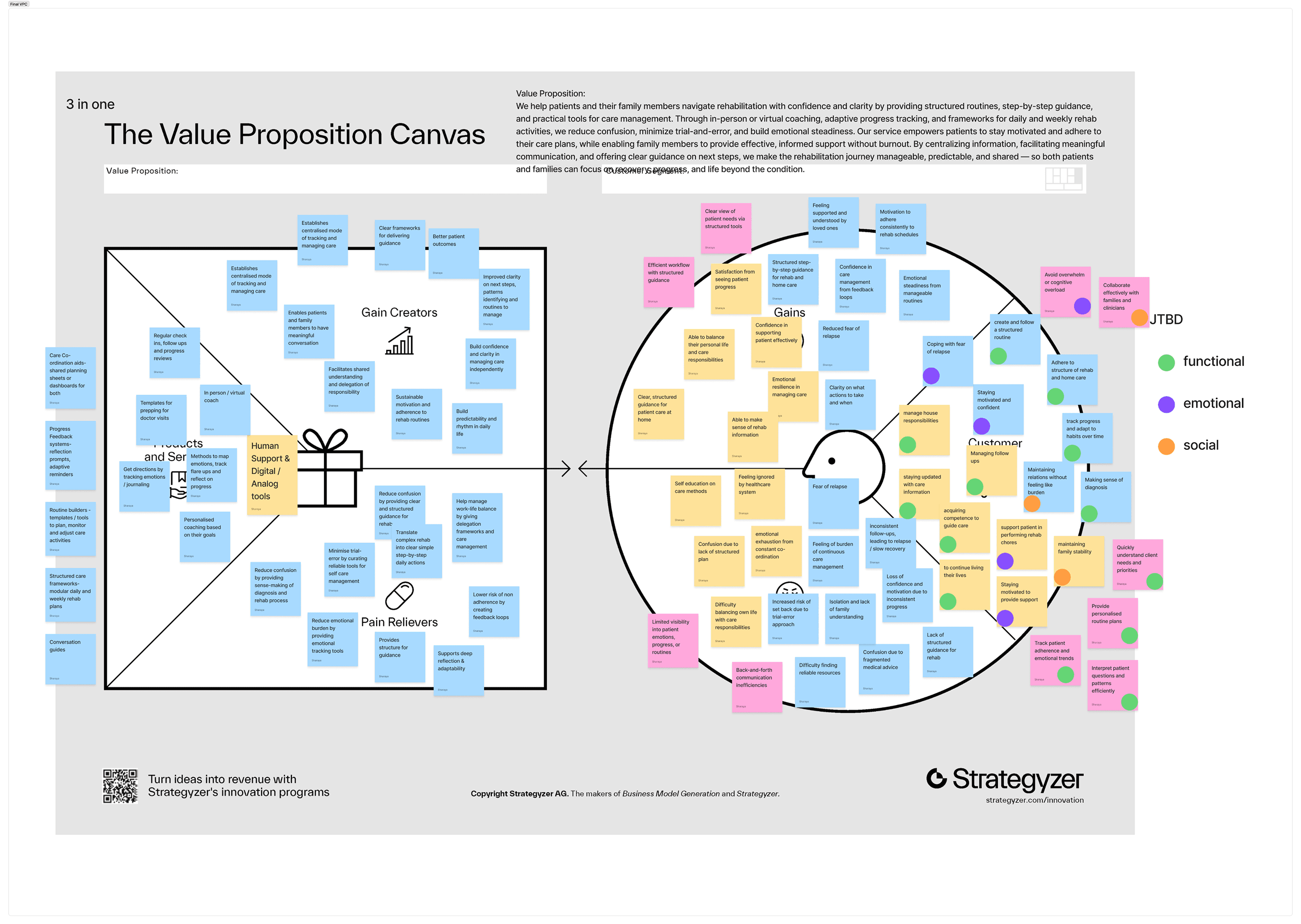
Value Proposition
Defining what Co-Care solves, for whom, and what changes
Co-Care brings a structured way through rehabilitation, with a verified coach to guide them and tools to follow the plan at home.
Business Model
How does Co-Care make money?
Co-Care is paid for by families, in a country where most care is already paid out of pocket. The model keeps the cost of starting low and the door open after the programme ends.

Layer 1: Why a try-out form
Families new to coaching shouldn't have to compare plans they don't yet understand. The form recommends one based on their situation, so they start in the right programme.
Layer 2: Why these plans
Rehabilitation takes months, so longer plans cost less per month. Instalments never cost more than paying upfront. Families who can't pay at once aren't penalised for it.
Layer 3: Why support continues
Setbacks are part of living with a rare chronic condition. After the programme, families can get help when they need it without committing to a new plan, and the free app keeps them connected, so coming back is easy.
Layer 4: Why later
Hospitals and NGOs will only fund a service with a track record. This layer is how Co-Care would scale, not how it starts
This is part 2 of Co-Care.
The research behind it, including interviews, market analysis and the three loops, is on a separate page.
Research - Co Care
Co-Care
Designing a care coaching service for patients with rare chronic conditions and their caregivers in India
Role
Product Designer
Team
Design Director
Development Team
Business Team
Tools
Figma
Sketch
Confluence
Jira
Timeline
2023 - 4 weeks
Full Time
Project
MA Service Design thesis
Supervised by
Prof. Jan-Christoph Zoels and Dr. Andrew Polaine
Role
Service Designer
Timeline
Oct-Apr 2026
OVERVIEW
The research showed that families manage recovery alone once treatment ends, caught in three loops of confusion, emotional strain and relapse.
Co-Care is the service designed in response.
It connects patients and caregivers, as one unit of care, with verified care coaches working in a non-clinical capacity. Families move through three stages: Prepare, where they put their needs into words; Align, where they are matched with a coach and agree on a plan; and Act, where the plan becomes daily routines, with support when things slip. They can return to any stage when something changes.
Beyond the app, the work defined the coach role and how coaches are verified, mapped how the service connects people, tools and organisations, and built a business model for families who pay out of pocket. The concept was tested through a concept video, a survey and four workshops with patients, caregivers and a practising care coach, and exhibited at Werkschau, HSLU's degree show.
This is part 2 of Co-Care.
The research- part 1, including interviews, market analysis and the three loops, is on a separate page.
Research - Co Care
Research - Co Care
Co-Care
Designing a care coaching service for patients with rare chronic conditions and their caregivers in India
Role
UX Researcher
Product -
Service Designer
Team
Design Director
Development Team
Business Team
Tools
Figma
Sketch
Confluence
Jira
Timeline
2023 - 4 weeks
Full Time
Project
MA Service Design thesis
Supervised by
Prof. Jan-Christoph Zoels and Dr. Andrew Polaine
Role
Service Designer
Timeline
Oct-Apr 2026
OVERVIEW
The research showed that families manage recovery alone once treatment ends, caught in three loops of confusion, emotional strain and relapse.
Co-Care is the service designed in response.
It connects patients and caregivers, as one unit of care, with verified care coaches working in a non-clinical capacity. Families move through three stages: Prepare, where they put their needs into words; Align, where they are matched with a coach and agree on a plan; and Act, where the plan becomes daily routines, with support when things slip. They can return to any stage when something changes.
Beyond the app, the work defined the coach role and how coaches are verified, mapped how the service connects people, tools and organisations, and built a business model for families who pay out of pocket. The concept was tested through a concept video, a survey and four workshops with patients, caregivers and a practising care coach, and exhibited at Werkschau, HSLU's degree show.
This is part 2 of Co-Care.
The research- part 1, including interviews, market analysis and the three loops, is on a separate page.
Research - Co Care